Classroom Walkthrough Strategies
From Principal Sarah Starr
Key Points of Quality Classroom Walkthroughs
- Classroom walkthroughs should reflect what a school truly values about learning.
- Effective walkthroughs start with shared beliefs, aligned expectations, and a culture of continuous improvement.
- Walkthroughs are not “Gotcha!” moments. They are tools for clarity, growth, and leadership.
- In special education classrooms, using walkthroughs to look for accessibility, explicit instruction, and communication support helps strengthen literacy outcomes for all learners.
- Walkthrough data should always lead to action, be it coaching, professional learning, or a celebration of strong practice.
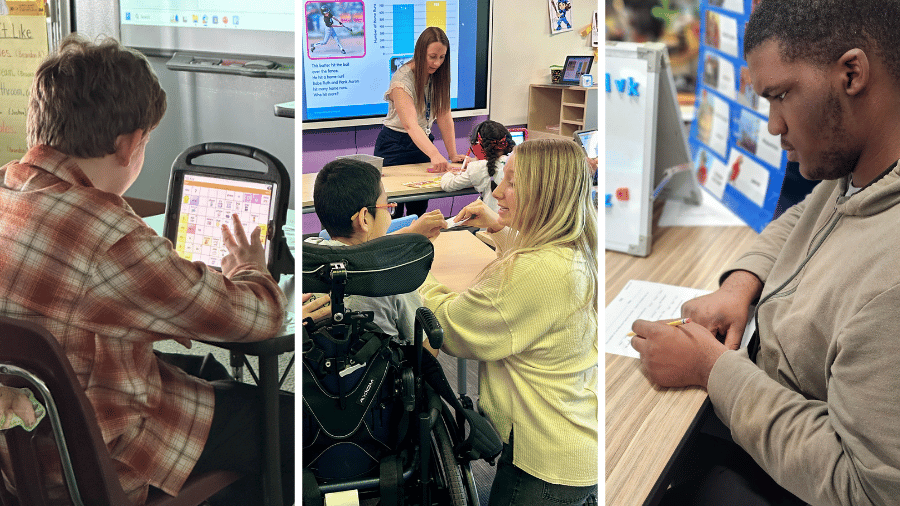
This is often the snapshot used to evaluate student achievement and educator performance. Many educators have experienced this type of “performative” classroom walkthrough. But walkthroughs can–and should–be something very different.
In schools that truly believe every student is a literacy learner, including students with significant and complex disabilities, walkthroughs are less about monitoring and more about noticing. What’s working well? Where are students being given real access to meaningful texts? Where can the teacher be more supported?
That’s when walkthroughs become opportunities to see instruction clearly and create conditions that help all learners make real literacy gains.
In a recent Building Wings webinar, Sarah Starr, principal of the Longview School in Montgomery County, Maryland, shared how she conducts meaningful, research-aligned and actionable walkthroughs. According to Starr, the best walkthroughs:
- Reflect a school’s values
- Establish clear expectations
- Are never punitive
- Use data to lead to action
- Improve learning for both students and educators
Why Classroom Walkthroughs Matter
Starr emphasized that walkthroughs are so much more than a leadership task. They are instructional leadership in action. They communicate priorities, shape school culture, drive consistency, and allow leaders to learn alongside staff.
Starr’s core message was simple and powerful: What you look for during classroom walkthroughs is what you value.
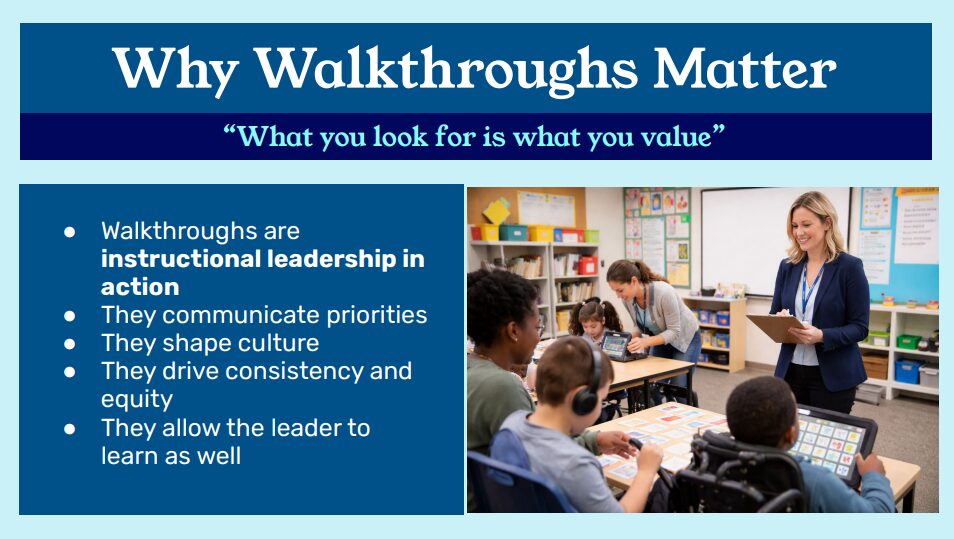
If leaders consistently notice and praise quiet classrooms and completed tasks, staff learn that compliance matters most. But when leaders deliver feedback on access, engagement, and instruction, particularly in special education classrooms, they send a very different message: that every student can learn.
When educators presume competence, literacy instruction is not a “reward,” but a right.
Using Research to Support the Why and What of Walkthroughs
Starr reviewed research sources to support the practice of walkthroughs and research-based instructional practices teams can use to develop expectations.
Sources of research on walkthroughs mentioned:
- Using Performance Feedback to Increase Special Education Teachers’ Use of Effective Practices
- Providing performance feedback to teachers: A review
Sources for research-supported instructional practices cited by Starr to use when developing walkthrough expectations include:
- Comprehensive Literacy for All by Erikson and Koppenhaver
- Teaching Exceptional Children by the Council for Exceptional Children
- Talking with Tech Podcast
Making Classroom Walkthroughs Meaningful
Before any walkthrough begins, Starr stressed the importance of defining what matters.
Starr outlines that the most effective classroom walkthroughs are grounded in:
Shared Belief
This is an opportunity for leaders to reflect on their own beliefs about student learning. Starr centers her work on “presuming competence”: the belief that all students are capable of learning, even when they require different supports, more time, or alternative communication systems.
Alignment With School Vision and Mission
Walkthrough expectations ideally align with what “success” looks like for students in that particular school or district. For Starr’s school, that mission includes increasing independence and quality of life through rigorous, collaborative instruction.
A Comprehensive Understanding of School Culture
Leaders do their jobs best when they know their staff and the context in which they’re working. Walkthroughs support growth only when they take place within a culture of psychological safety, collaboration, and the expectation of continuous improvement.
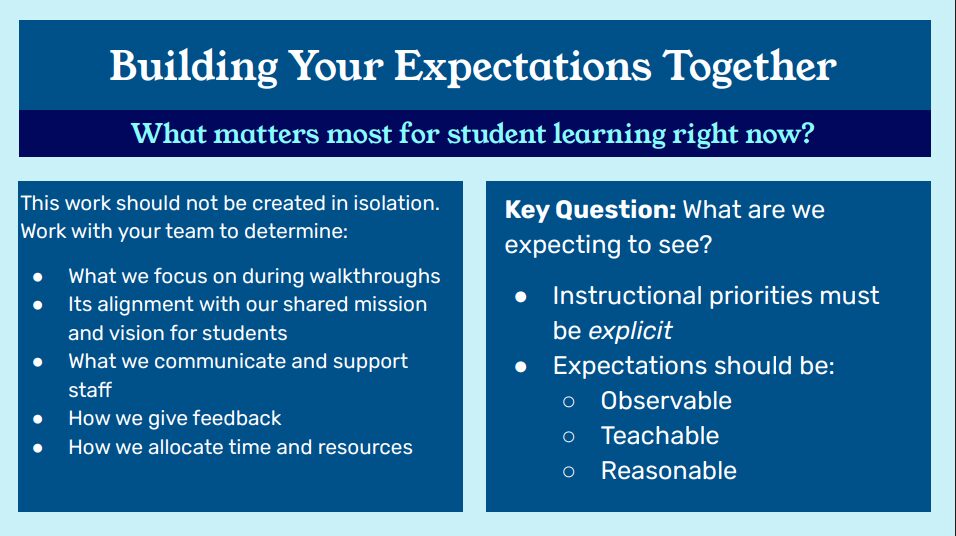
Co-created Expectations
Instructional priorities are collaborative creations. Starr works with both formal and informal leaders to define clear, observable, and reasonable expectations for instruction. This clarity builds momentum, delegates ownership, and ensures consistency across classrooms.
When walkthrough outcomes are built together and shared, walkthroughs themselves feel less like moments of judgment and more like opportunities to demonstrate alignment.
Establishing Clear Expectations
Starr noted that walkthrough expectations should be:
- Observable
- Teachable
- Reasonable
In practice, that means leaders and educators agree on what matters most for student learning right now. Not everything, and not all at once, but right now.
In literacy classrooms, especially those serving students with complex learning profiles, this often means naming priorities such as:
- Explicit literacy instruction
- Access to communication
- Alignment with IEP goals
- Meaningful literacy outcomes
- Consistent instructional routines
How Classroom Walkthroughs Focus on Instructional Practice
Once expectations are clear, walkthroughs can shift from whether instruction is happening to how it’s happening.
A literacy-focused walkthrough might take note of:
- Whether students know what they’re learning
- Whether instruction is explicit, not just questioning
- Whether students get time to practice and respond
- Whether instruction is adapted so that all learners can participate
Busy classrooms can sometimes make it hard to see whether instruction is happening. Walkthroughs help leaders slow down and really see the learning.
Classroom Walkthroughs and Accessible Literacy Instruction
For many students, literacy is only possible when communication supports are present. That’s why meaningful classroom walkthroughs notice things like:
- AAC modeling by adults
- Opportunities for students to communicate throughout the lesson
- Instruction that connects to student interests
- Adults speaking with students, not around them
When leaders notice and name these practices, they reinforce the essential truth that communication is not separate from literacy. Rather, it’s foundational to it.
Walkthroughs Should Feel Safe
This kind of work succeeds only when walkthroughs feel safe, not performative or punitive. Their purpose is growth, trust, and shared responsibility for learning.
When teachers understand that walkthroughs are connected to coaching, professional learning, and genuine support, they’re more likely to reflect, collaborate, and try new strategies.
Using Walkthrough Data to Improve Literacy Instruction
Even the best walkthrough is just a snapshot of a much larger environment. The real impact comes afterward.
When leaders step back and look across classrooms, they can recognize patterns. These patterns help answer important questions like:
- What’s working well across the school?
- Where do teachers need more support?
- What should future professional learning focus on?
Walkthrough data should always lead to action. That action can be targeted coaching, shared learning, or even simply naming and celebrating a strong instructional practice.
Classroom Walkthroughs Matter For Literacy and Equity
At their best, classroom walkthroughs are equity work. They help ensure that students with significant disabilities are not just present, but taught. They are opportunities to notice whether literacy instruction is consistent across classrooms.
Clear expectations paired with thoughtful walkthroughs create more predictable instruction. And that leads to better outcomes for both students and educators. To explore this topic further, an on-demand replay is available of Principal Sarah Starr’s, webinar on Meaningful Administrative Walkthroughs: A School Principal Shares Her Research-Aligned Strategy.