6 Myths About Literacy:
Why and How They Hold Educators
and Students With Disabilities Back
From the Desk of Maureen Donnelly, M.Ed.
In literacy education, the beliefs we hold shape the opportunities children receive, including beliefs about:
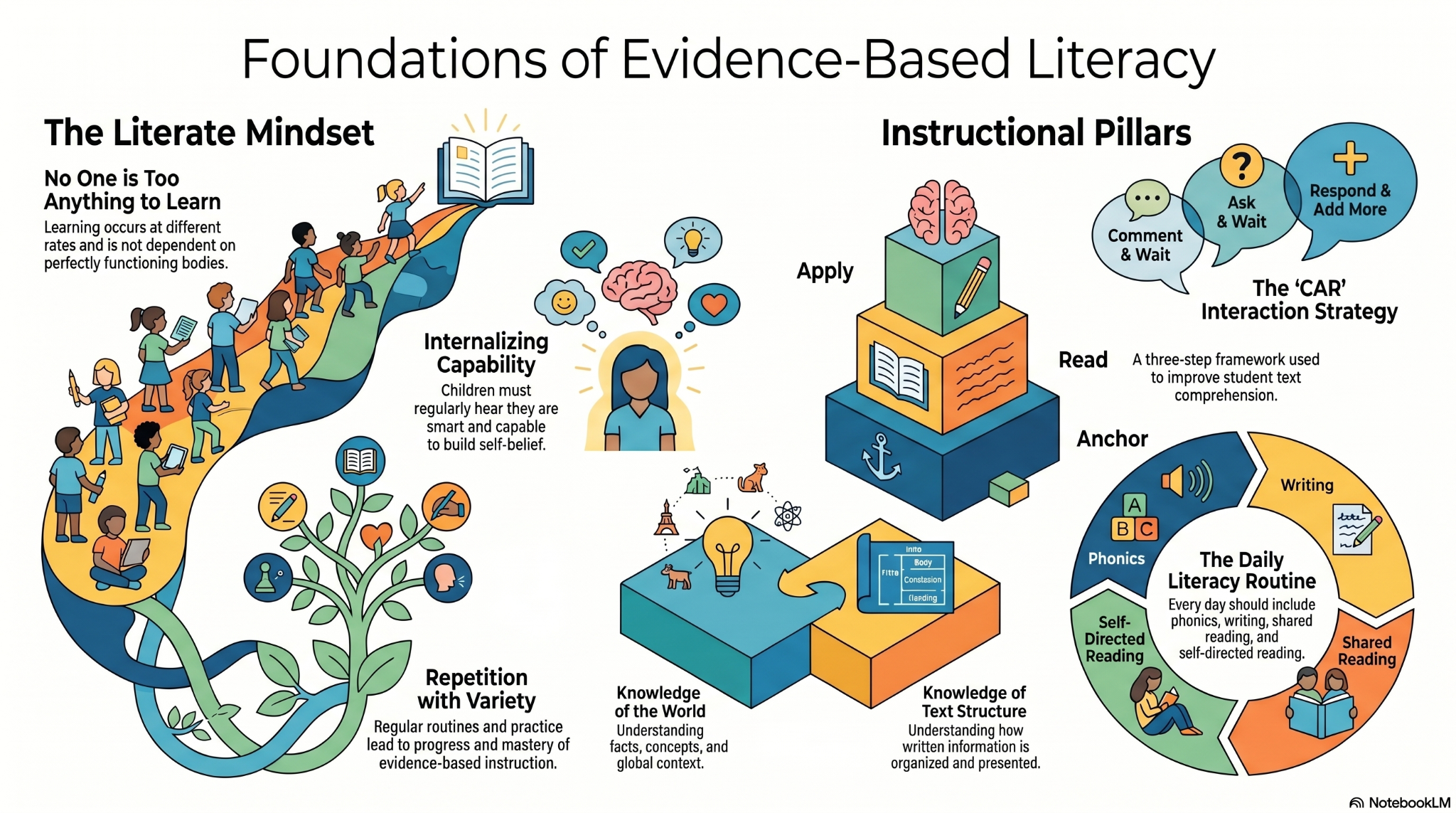
• Who can learn
• How learning occurs
• What constitutes progress

These beliefs affect every student, but they create the most significant challenges for students who need extra support, including students with disabilities, multilingual students, and students from historically disadvantaged backgrounds.
Recently, I was a guest on Caroline O’Hearn and Sara Pericolosi’s All Means All podcast to discuss multiple instructional myths that research proves wrong, although they persist in educational practice. The process of removing these myths functions as an equalizing system.
The following six myths were examined on the podcast, along with their reasons for elimination and alternative solutions.
Myth #1: Not Everyone Can Learn to Read.
The belief that reading skills are inaccessible to certain students results in wrong student placement decisions and inappropriate teaching approaches, which also makes students question their academic abilities.
However, the research of the last 25 years continues to tell a different story: all children can learn to read and write when provided with effective instruction and appropriate support. The Preventing Reading Failure in America report by Lyon & Fletcher (2001) outlines that “Reading failure is not inevitable; it is preventable for the vast majority of children.”
Myth #2: Language Must Precede Literacy.
The belief that students must demonstrate certain oral language milestones before engaging in literacy instruction is deeply ingrained and deeply inaccurate. There is no evidence that a learner must achieve a specific set of oral language skills before receiving reading and writing instruction. Instead, the responsibility falls on us as educators to ensure that every student has a reliable means of communication, including AAC when needed. Effective and evidence-based instruction, particularly as it relates to emergent learners, invites learners to share their thoughts. A student can’t do this without a means by which to communicate.
Koppenhaver and colleagues’ foundational framework positions reading, writing, listening, and speaking as mutually reinforcing, transactive processes. Growth in one supports growth in all. Delaying literacy instruction until a learner “masters” oral language milestones doesn’t protect their progress; it stalls it.
Since the purpose of public education is to cultivate informed, participatory citizens, literacy instruction must be accessible to every learner from the start. There are few things citizens can do without the ability to read and write.
Myth #3: Literacy Develops Primarily Through School-based Instruction.
School plays a vital role in literacy development, but it is not the only place where literacy begins or develops.
Long before learners walk through a school door, they are already building an internal framework for reading and writing. This early period, known as emergent literacy, encompasses the knowledge, behaviors, and understandings that precede conventional literacy. Researchers such as Dr. Karen Erickson remind us that emergent literacy is not a list of skills to be mastered. It is a developmental stage that emerges and evolves.
It makes sense then, to characterize emergent literacy as stage-dependent, rather than age-dependent. A learner may be 5, 15, or 50 years of age and still be in the emergent stage. This variation reflects access, opportunity, communication supports, and experiences, not ability or potential. For learners with disabilities in particular, the emergent literacy stage begins later, due to limited access to meaningful literacy interactions earlier in life.
When we treat emergent literacy as something learners should “grow out of” by a certain age, we risk denying many students the experiences, instruction, and explorations they need and deserve.
Another central truth: emergent literacy experiences cannot be “trained” through drills or worksheets. They emerge naturally through immersion, interaction, modeling, and guided participation in a world rich with print and language. Whether a learner is watching someone write a grocery list, exploring a book through touch, listening to a story, co-creating a message on an AAC device, or playing with letter shapes, they are building the conceptual foundations of reading and writing. These experiences accumulate gradually, not through isolated practice, but through repeated cycles of participation and meaning-making.
Finally, literacy development does not stop at the end of the emergent stage, and it does not stop in adolescence. Literacy is a lifelong developmental journey, continually shaped by experience and practice, as new texts, contexts, technologies, and purposes for reading and writing occur. I am still growing as a reader and writer and so is every person reading this. When we position literacy development as a linear, school-bound process, we underestimate its complexity and its deeply human nature.
Understanding that literacy begins before school, extends far beyond school, and unfolds uniquely for every learner helps us design learning environments that meet students where they are and move with them forward. It reminds us that literacy is not something we deliver to students; it is something we build with them, over time, through experience, and in relationships.
Myth #4: Literacy Develops Through Phonics Only—or Phonics First.
The Science of Reading (SoR) has played an invaluable role in elevating explicit, sequential, and systematic phonics instruction. This is essential for word recognition and, later, reading with comprehension. But the research has never claimed that phonics alone is sufficient.
Across analyses by the National Reading Panel, the National Early Literacy Panel, and related bodies, the evidence is remarkably consistent: readers require diverse, daily instruction across all pillars of literacy including vocabulary, oral language, comprehension, writing, and phonological awareness. Much of the SoR does not focus on students with specific word-level challenges, such as dyslexia or phonological impairments. Frameworks like comprehensive literacy instruction expand this understanding, supporting learners before they demonstrate the skills outlined in Scarborough’s Rope.
Myth #5: Pairing Pictures or Symbols with Words Accelerates Literacy Learning.
This practice is well-intentioned but counter-indicated by more than six decades of research.
Pairing pictures or symbols with printed words forces learners to split their attention between images and text. Marilyn Adams, in her book Beginning to Read (1990), reminds us that readers must learn to “look at and through words.” When students rely on pictures for meaning, they are not developing the decoding and orthographic mapping skills that learners need to read conventionally and independently.
As Dr. David Koppenhaver has said, “Let’s agree not to teach kids things we later have to unteach them.” To date, there are no symbol supports on a Starbucks menu or on voting ballots. Symbol-supported text can support communication, but it does not strengthen literacy development.
Myth #6: Testing is Teaching.
Students with disabilities are assessed more often than their peers. Browder et al. (2006) documented that excessive mastery-based testing narrowed the curriculum, reduced access to authentic literacy tasks, and limited growth opportunities.
Across decades of studies, a clear pattern emerges: instructional time, not assessment frequency, is the strongest predictor of literacy growth for students with disabilities.
Koppenhaver & Erickson (2003) found that students with significant disabilities made the most progress in classrooms where they engaged in daily, meaningful reading and writing, not in classrooms dominated by progress monitoring. Ruppar et al. (2017) reinforced this finding, demonstrating that literacy gains are correlated with high-quality instruction.
We must also consider learner identity and feelings of efficacy. Repeated assessment, especially in test-like contexts where learners may experience repeated failure, can erode confidence, motivation, and interest. By contrast, rich, relational, and connected literacy instruction (Erickson & Koppenhaver, 2020) fuels engagement, and engagement in turn fuels literacy development.
Assessment is essential, but it is not the engine of literacy growth, especially for learners with disabilities. Research suggests a balance of 90 percent instruction to 10 percent assessment, emphasizing instruction over assessment. It’s important to remember: We don’t test students into literacy. We teach them. And we do that through daily, comprehensive, human-centered instruction.
Why Literacy Myths Exist and What to Do About Them
These myths linger because they’ve been repeated, and they may feel familiar, but that doesn’t mean they are based in research or are beneficial to students. If you are working to use more research-supported literacy instruction strategies, you don’t need to change everything at once. Lean into one belief, shift one routine, or try one new strategy and watch how these changes open possibilities for the learners you work with.
Challenging myths is part of advocating for students. Literacy instruction research guides us, and our day-to-day decisions put that research into action. When we ensure access, a means of communication for all learners, and research-based instruction, we set the stage for all learners to soar.
About the Author:

Maureen Donnelly, M.Ed., Director of Curriculum at Building Wings, is an early childhood educator by training who has worked with students of diverse ages and abilities, from preschool through college.
Throughout her 25-year career, Maureen has developed numerous products and written hundreds of books that support the literacy learning needs of beginners. as well as
If you are looking for more of Maureen, watch her on-demand webinars:
AAC Literacy Instruction: Boosting Access, Engagement and Independent Learning