
Engaging Literacy Instruction
for Students with Complex Needs
What Does Comprehensive Literacy Instruction
Look Like?
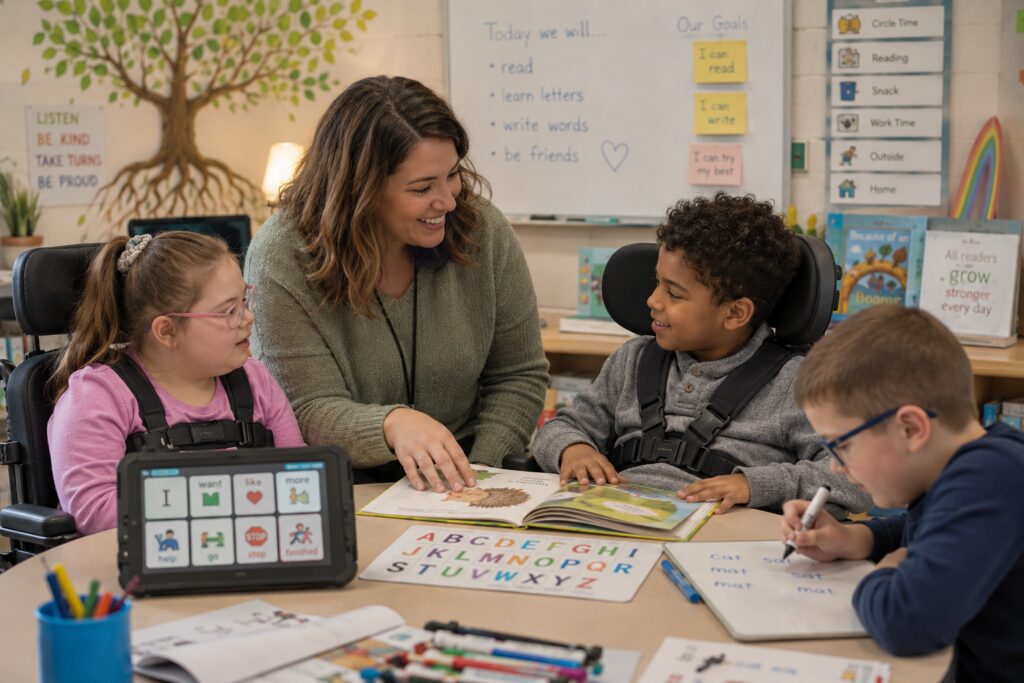
Comprehensive literacy instruction gives every student meaningful opportunities to develop reading, writing, language, and communication skills, regardless of their abilities or support needs.
For students with complex learning needs, literacy instruction goes beyond recognizing sight words, matching pictures, or completing worksheets. It includes the essential components of literacy instruction that benefit all learners:
Shared reading:
Building language, comprehension, and understanding of print through engaging texts.
Independent reading:
Exploring books, making choices, and developing reading behaviors.
Writing:
Expressing ideas using pencils, keyboards, alternative pencils, or assistive technology.
Alphabet and word instruction:
Explicitly teaching letters, sounds, decoding, and word recognition.
Language and communication:
Developing vocabulary, background knowledge, and opportunities to express ideas.
Access makes participation possible. Students may use AAC, alternative writing tools, or adapted response methods to engage in meaningful literacy instruction. These supports change how students participate, not what they deserve to learn.
The goal isn’t simply participation. It’s consistent, evidence-based instruction that helps students become increasingly independent readers, writers, and communicators.
5 Practical Strategies for Engaging Students with Complex Needs
Engagement is important, but participation alone is not evidence of literacy learning. Effective instruction gives students repeated opportunities to read, write, communicate, and apply new skills with increasingly independent responses.
1. Make shared reading interactive
Use age-respectful, interesting texts. Model how readers make meaning, draw attention to print, invite predictions, and offer multiple ways to respond. A student may point, use eye gaze, select an AAC message, or respond verbally. Revisit texts to build familiarity without reducing the lesson to answering the same questions.
2. Protect time for independent reading
Offer accessible books students can choose and explore, including books with appropriate visual, physical, or digital supports. Teach students how to access and navigate books. Choice and access support participation, while teacher observation helps identify the reading behaviors and instruction each student needs next.
3. Make writing a daily opportunity
Invite students to communicate authentic ideas through predictable chart writing, journaling, shared writing, or other meaningful activities. Provide pencils, keyboards, alternative pencils, switches, or other access methods. Do not require handwriting or speech before allowing a student to compose a message.
4. Teach the alphabetic system explicitly
Pair meaningful reading and writing with systematic instruction in phonological awareness, letter-sound relationships, decoding, and word recognition as appropriate to the learner. Provide modeling, guided practice, feedback, and opportunities to apply new learning in connected text. Pictures and symbols may support communication, but they do not replace learning to read print.
5. Connect literacy to knowledge and communication
Use science, social studies, and relevant everyday topics to build vocabulary and background knowledge. Invite students to ask questions, express opinions, and discuss ideas with the communication tools they use. The goal is not merely to complete an activity; it is to strengthen language, understanding, and literacy over time.
How Can Nonspeaking Students Participate in Literacy Instruction?
Students do not need to speak to learn to read or write. Educators can offer AAC, partner-assisted scanning, eye gaze, switch access, adapted books, and alternative writing tools so learners can participate in the same instructional purpose as their peers. A student might select a word to complete a shared sentence, use AAC to comment on a story, or compose with an alternative pencil.
Access and instruction work together. First, remove the barrier that prevents the student from responding; then provide intentional teaching, feedback, and opportunities to demonstrate growth. Do not confuse a student’s current response method with the limits of what that student can learn.

What Should Administrators Look for in a Special Education Literacy Curriculum?
When evaluating a special education literacy curriculum, look beyond the number of activities, worksheets, or levels offered. Ask whether the materials support comprehensive literacy instruction across a wide range of learners and whether teachers can deliver instruction consistently.
Look for explicit teaching of foundational reading skills alongside meaningful reading, writing, language, and knowledge building. Examine how the curriculum supports AAC and alternative access, provides age-respectful content, aligns with applicable standards, and helps teachers observe and respond to student learning. Ask what onboarding, professional learning, and implementation guidance educators will receive.
Most importantly, distinguish measures of curriculum use from evidence of student learning. A dashboard may show that lessons were completed; educators and administrators also need meaningful ways to understand what students are learning and what instruction should happen next.
How Readtopia® Supports Comprehensive Literacy Instruction
Readtopia helps educators connect literacy with meaningful content through thematic learning experiences and instructional resources. Rather than asking teachers to assemble disconnected materials, it offers a structure for integrating reading, writing, language, and content-area learning while adapting access for students with complex support needs.
ReadtopiaGO™ supports younger emergent learners with developmentally appropriate literacy experiences. Together, these resources can help teams plan consistent instruction while maintaining high expectations and preserving the teacher’s role in modeling, responding, and making instructional decisions.
Explore Readtopia and ReadtopiaGO to see how Building Wings supports comprehensive literacy instruction in special education classrooms.
Frequently Asked Questions
Can students with complex support needs learn to read and write?
Yes. Students with complex support needs deserve access to comprehensive literacy instruction and opportunities to develop as readers and writers. Instruction and access methods should be individualized without assuming a student’s potential is fixed.
Is shared reading enough to teach reading?
No. Shared reading builds language, comprehension, engagement, and understanding of print, but it is one part of comprehensive literacy instruction. Students also need opportunities for writing, independent reading, and explicit instruction in foundational reading skills.
Does AAC replace literacy instruction?
No. AAC supports communication and participation. It can help students engage in literacy lessons while they receive explicit instruction in reading and writing.
Next Steps
Explore Building Wings’ comprehensive literacy resources and learn how Readtopia can support meaningful literacy instruction for students with complex support needs. Contact our team at soar@buildingwings.com to discuss instructional goals and curriculum fit.