Building Number Sense for Students
With Significant Disabilities
A student can say, “one, two, three, four, five.”
But does that mean the student understands five?
It’s an important distinction, particularly when we think about math instruction for learners with significant disabilities.
For years, we have challenged assumptions about what students with significant disabilities can learn in literacy. We have pushed for access to comprehensive literacy instruction, meaningful texts, communication, and real opportunities to grow as readers, writers, and communicators.
Now is the time to bring that same thinking to mathematics.
Because counting is about much more than remembering a sequence of number words.
What Does it Actually Mean to Understand a Number?
Understanding a number means more than knowing its name or where it falls in a counting sequence. It means understanding the quantity it represents, how it relates to other numbers, and the different ways it can be represented.
Let’s think about a student who can successfully recite the numbers from 1 to 10.
Now ask:
- Can the student give you five objects?
- Can they determine which of two groups has more?
- Do they understand that five objects are still five objects when those objects are rearranged?
- Can they represent five in different ways?
- Can they understand that two objects and three more objects make five?
- Can they use what they know about five to reason about another quantity?
These questions get us much closer to number sense.
Research on children’s development of number knowledge has long distinguished between performing a counting procedure and understanding what that counting represents. A child may correctly say the final number in a counting sequence without yet fully understanding the cardinal principle: that the final number counted tells us how many objects are in the entire set.
That difference matters when we think about instruction.
Number Sense is Bigger Than Counting
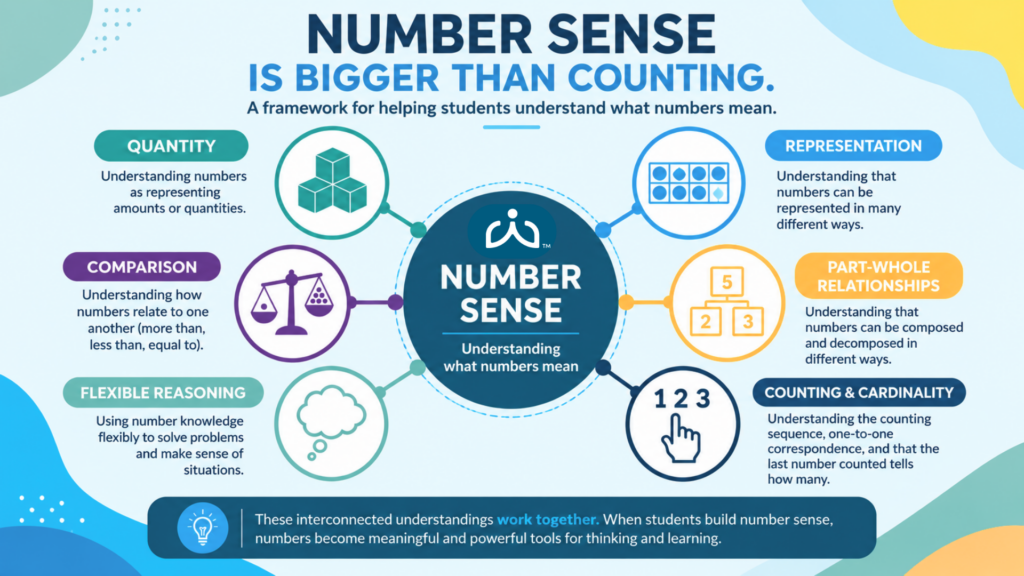
During a recent Building Wings webinar on Learning Numbers, Dr. Claire Greer shared a framework that places number sense at the center of several connected mathematical understandings:
Quantity. Counting and cardinality. Comparison. Representation. Part-whole relationships. Flexible reasoning.
The point is not simply to practice each skill separately. These understandings work together.
As students develop number sense, numbers become more than words to recite or symbols to identify. They begin to represent quantities, relationships, and ideas that students can reason about.
For students with significant cognitive disabilities, that means our goal cannot stop when a student can recite the numbers.
We want students to understand what numbers mean.
Why is Counting Instruction Important for Students with Significant Cognative Disabilities?
Counting is one of the earliest ways students begin making sense of quantity. It helps build the foundation for later mathematical thinking and supports everyday problem solving and greater independence.
In their 2019 article, “Teaching Students With Significant Cognitive Disabilities to Count: Routine for Achieving Early Counting,” Drs. Claire Greer and Karen Erickson describe counting as foundational to later mathematical understanding. They also emphasize the importance of giving students with significant cognitive disabilities structured, repeated opportunities to develop both the procedural and conceptual aspects of counting.
Their work describes an instructional routine that combines distributed learning with brief periods of explicit instruction. Designed as one part of a comprehensive approach to mathematics instruction, the routine typically takes about 15 minutes to complete.
Read Greer and Erickson’s article through the Council for Exceptional Children.
That research helped shape Learning Numbers, a research-based daily math routine within Readtopia® and ReadtopiaGO™ designed to help students with significant cognitive disabilities build foundational number sense. Short, predictable, accessible routines focus on early counting, one-to-one correspondence, and cardinality, while clear “say and do” guidance gives educational teams practical support for delivering instruction.
Read Greer and Erickson’s article through the Council for Exceptional Children.
Reciting Numbers and Understanding Numbers are Not the Same Thing
One of the most useful questions we can ask is:
Are we measuring what students can recite, or are we finding out what they understand?
A student counts five objects:
“One, two, three, four, five.”
Then the teacher asks, “How many are there?”
If the student starts counting the objects again, that tells us something.
If the student immediately says “five,” that may tell us something different.
Cardinality is the understanding that the final number indicates when counting represents the quantity of the entire set.
Research comparing procedural counting with conceptual understanding shows why we should not assume that success with one automatically means mastery of the other. Research involving children with Down syndrome, for example, has examined procedural counting separately from conceptual understanding of cardinality.
Other research has found that children’s understanding of cardinality is associated with later growth in their understanding of relationships among symbolic numbers.
So instead of stopping at:
“Can the student count?”
We can ask:
“What does the student understand about what they just counted?”
That is a much richer instructional question.
What Might Stronger Instruction Look Like?
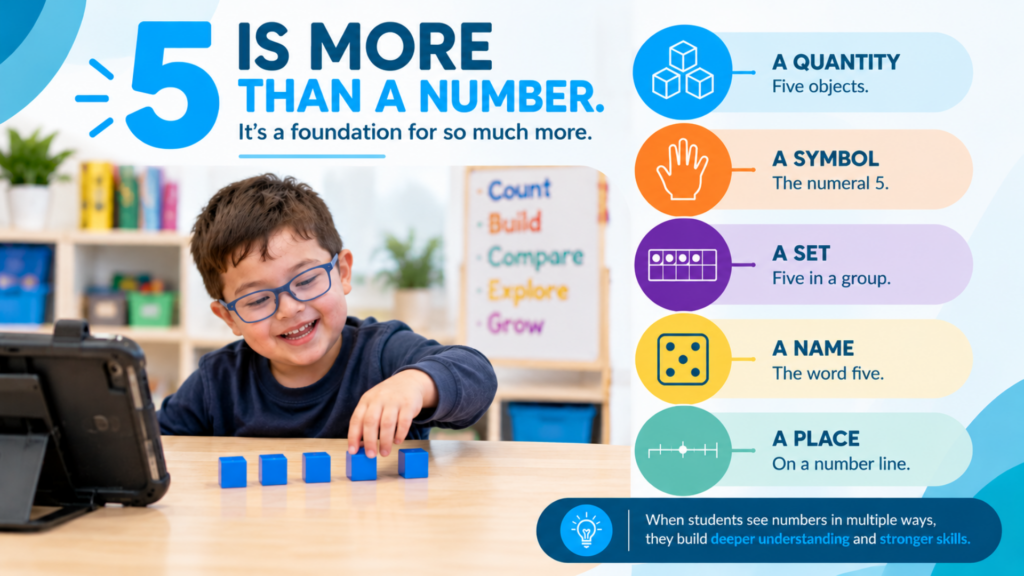
Number sense grows through varied experiences that help students connect numbers to quantities, representations, relationships, and real-world contexts.
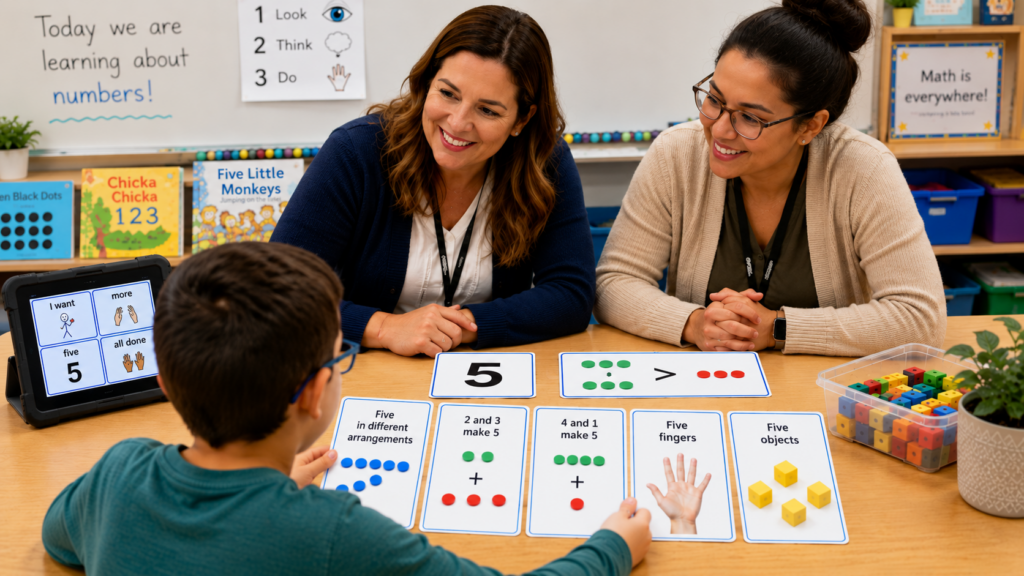
For example, rather than practicing “five” only by counting five identical objects, a student might:
- count five objects,
- create a group of five,
- find five within a larger collection,
- compare five objects with three objects,
- match the numeral 5 to a quantity,
- see five represented in different arrangements,
- break five into two and three,
- add one to four to create five, and
- encounter five repeatedly during meaningful activities.
The goal is not more worksheets about the number five.
The goal is to help a student develop a deeper understanding of what five actually means.
Research on counting interventions supports this attention to conceptual knowledge. One study found that improvements in children’s ability to label the size of sets supported growth in their understanding of cardinality.
For students with significant cognitive disabilities, these opportunities also need to be accessible. Students may use adapted materials, alternative response modes, augmentative and alternative communication, modeling, repetition, or other supports to participate fully.
Access can change how a student engages with the mathematics.
It should not determine whether that student gets to engage in mathematical thinking at all.
Why Predictable Math Routines Matter
Teachers supporting students with significant cognitive disabilities are already balancing an enormous number of instructional demands.
The answer cannot simply be, “Do more math.”
The instruction has to be both meaningful and doable.
That is where predictable routines can help. A consistent routine gives teachers a clear instructional pathway while giving students repeated opportunities to encounter important mathematical ideas.
Greer and Erickson note that routines can provide the predictable, extensive, repeated instruction students with significant cognitive disabilities may need, while still allowing educators to adapt materials and access for individual learners.
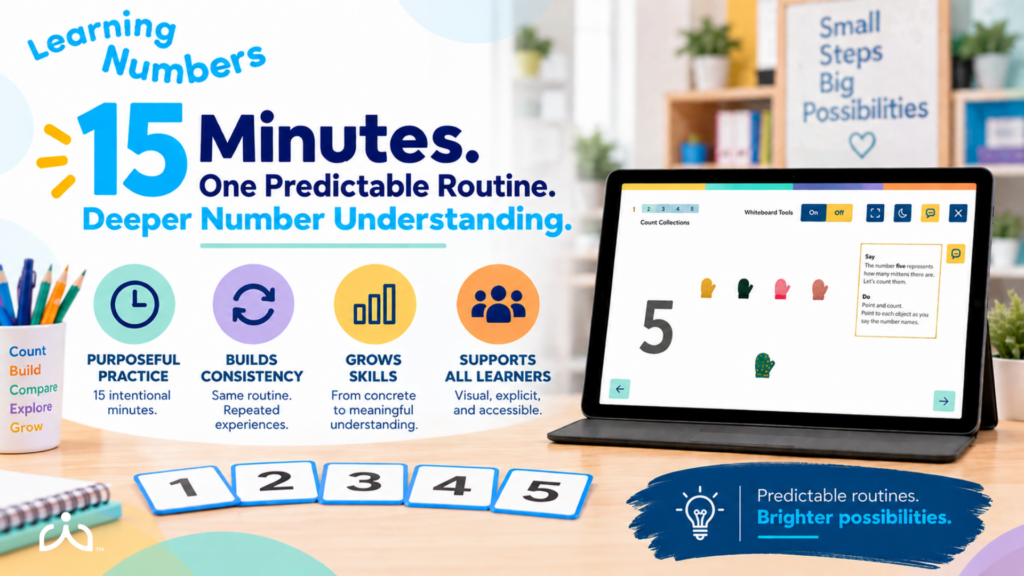
Learning Numbers brings that idea into daily instruction through an interactive routine designed to build early counting skills through predictable experiences that connect concepts and practice.
For districts, this is where the conversation gets interesting.
Instead of every teacher independently figuring out how to teach foundational number concepts, what if educators had a shared, research-based instructional routine?
Fifteen intentional minutes every day can become much more than counting practice.
It can become time devoted to building mathematical understanding.
Five Questions Districts Should Be Asking About Math Instruction
For special education leaders, curriculum directors, instructional coaches, and school administrators, the conversation about access to mathematics should go beyond whether students have a math curriculum.
Consider asking:
- Are students learning to understand quantities, or primarily learning to recite number sequences?
- How are teachers assessing conceptual understanding in addition to task completion?
- Are students receiving systematic instruction in counting, cardinality, comparison, representation, and number relationships?
- Do teachers have accessible instructional routines they can implement consistently?
- Do we hold the same expectations for meaningful mathematics learning that we increasingly hold for literacy?
That last question is worth sitting with.
What if We Reconsidered What's Possible in Mathematics?
The field of special education has spent years reconsidering assumptions about literacy.
We have seen what changes when students are given access to meaningful instruction, communication, and opportunities to demonstrate what they know.
Mathematics deserves the same kind of attention.
A student reciting “one, two, three, four, five” may be demonstrating an important skill.
But that should spark our curiosity, not end our instruction.
Does the student understand five?
Can they represent five?
Can they compare five?
Can they compose and decompose five?
Can they reason with five?
Those questions move us from helping students recite numbers to helping them understand numbers.
And that is where mathematics begins.
What is number sense?
Number sense is an understanding of numbers, quantities, relationships, and representations. It includes more than counting correctly. Students with number sense begin to understand what numbers mean and how numbers relate to one another.
Frequently Asked Questions
What is cardinality?
Cardinality is the understanding that the final number said when counting tells how many items are in the entire set. A student may be able to count objects correctly without yet understanding this concept.
How can teachers build number sense for students with significant cognitive disabilities?
Teachers can build number sense through explicit, repeated, accessible instruction that connects counting to quantity, comparison, representation, and number relationships. Predictable routines, adapted materials, AAC, alternative response modes, and repeated practice can help students participate meaningfully.
Why is counting more than reciting numbers?
Reciting a sequence such as “one, two, three, four, five” demonstrates knowledge of number words. Understanding five requires more. A student also needs opportunities to connect the word and numeral to quantity, compare five with other amounts, represent five in different ways, and reason about its relationship to other numbers.
Learn More About Math Instruction and Number Sense:
Explore the research behind early counting instruction for students with significant cognitive disabilities: